Can Shared Meals Strengthen Workplace Culture?
Published on 10 October 2026 Aman Sagar 6 min read
Shared meals can support workplace culture by creating regular opportunities for informal conversation and relationship-building. The World Happiness Report 2025, Belot and Hakimov (2025), and Reichman and Dodelzon (2026) suggest that social connection may matter for how people experience work, but meals alone do not prove higher engagement or productivity. HR should measure connection, engagement and performance separately.
A shared lunch can put colleagues at the same table. It cannot, by itself, create workplace culture.
For HR, the useful question is what happens around the meal: whether people talk, meet colleagues outside their usual circle and build familiarity. Lunch satisfaction, stronger relationships and business performance are different outcomes and need different measures.
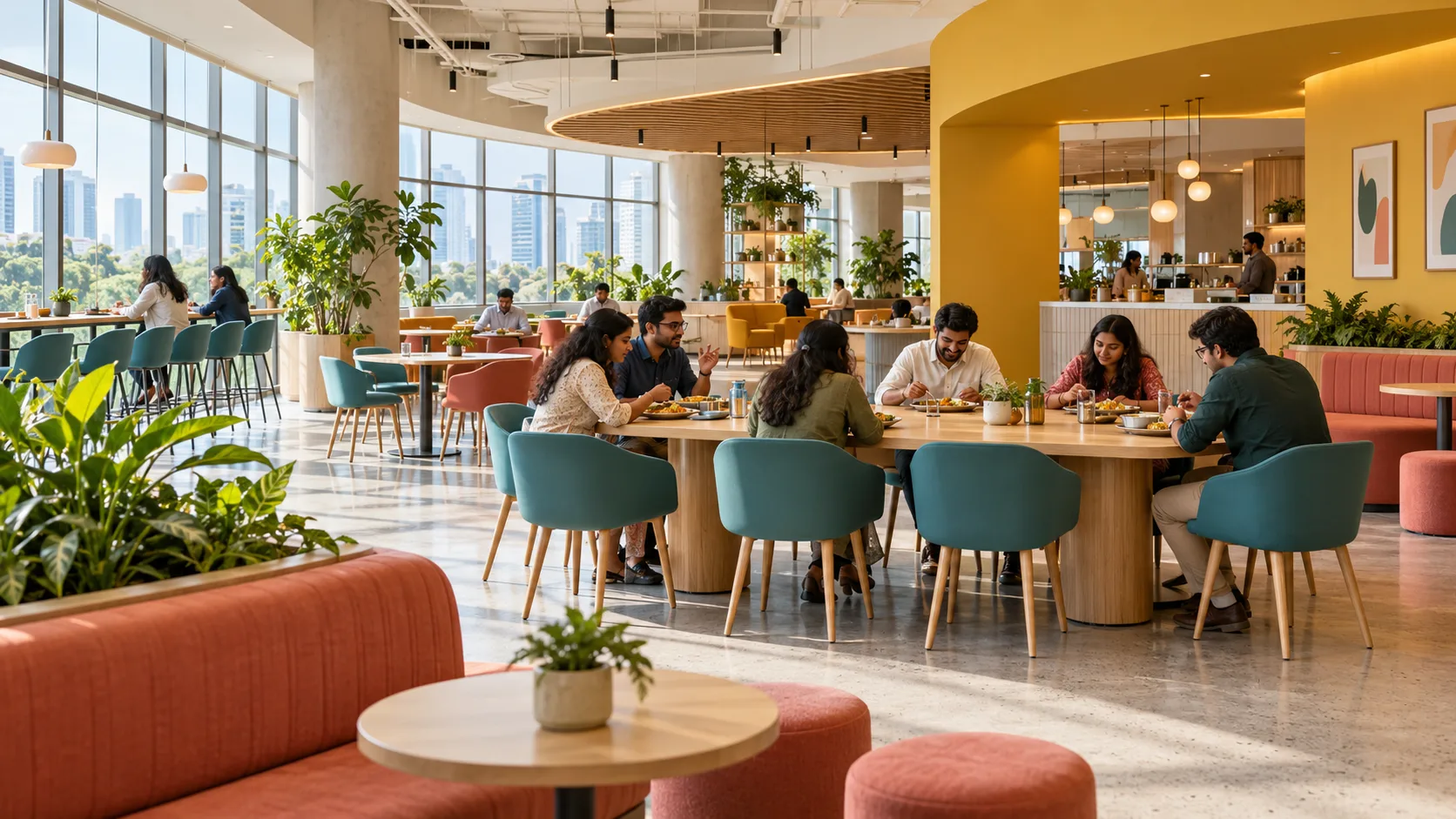 Colleagues sharing lunch around a table in a modern workplace dining area.
Illustrative workplace dining image; not a WeCare workplace. Credit/rights to be confirmed before publication.
How can shared meals help employees connect?
The broadest evidence starts outside the workplace. The World Happiness Report 2025 analysed 2022–2023 meal-sharing data from 142 countries and territories and more than 150,000 respondents. People sharing more meals reported higher wellbeing, and meal sharing was associated with some measures of social connection (World Happiness Report, 2025).
That is context, not proof that an office lunch programme improves culture. The study is not an Indian workplace intervention, and causality remains unresolved. The narrower interpretation is simple: a shared meal can create repeated opportunities for informal conversation.
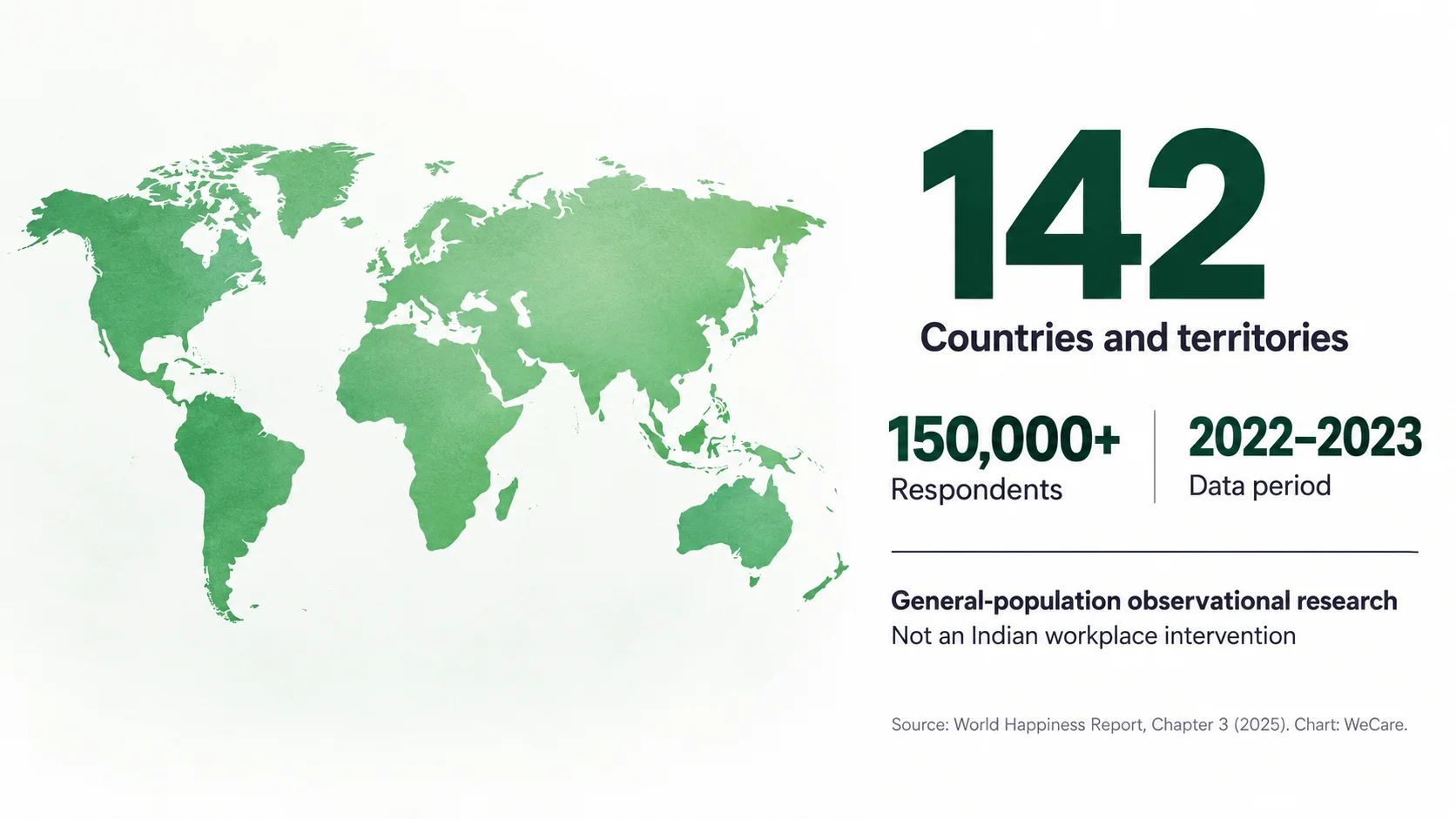 World map graphic showing meal-sharing research covering 142 countries and territories, more than 150,000 respondents, during 2022–2023.
Meal-sharing evidence spans 142 countries and territories and 150,000+ respondents; general-population observational research, not an Indian workplace intervention. Source: World Happiness Report, Chapter 3 (2025). Chart: WeCare.
The meal is an opportunity for interaction, not the outcome itself.
Do workplace friendships matter for employee engagement?
They can matter to how employees experience work, but friendship and engagement are not the same measure.
In a Compass Group / Mintel 2024 vendor-sponsored survey of 30,075 workers and students across 21 countries, 70% of employees with a friend at work said they looked forward to work, compared with 25% of those without one (Compass Group / Mintel, 2024).
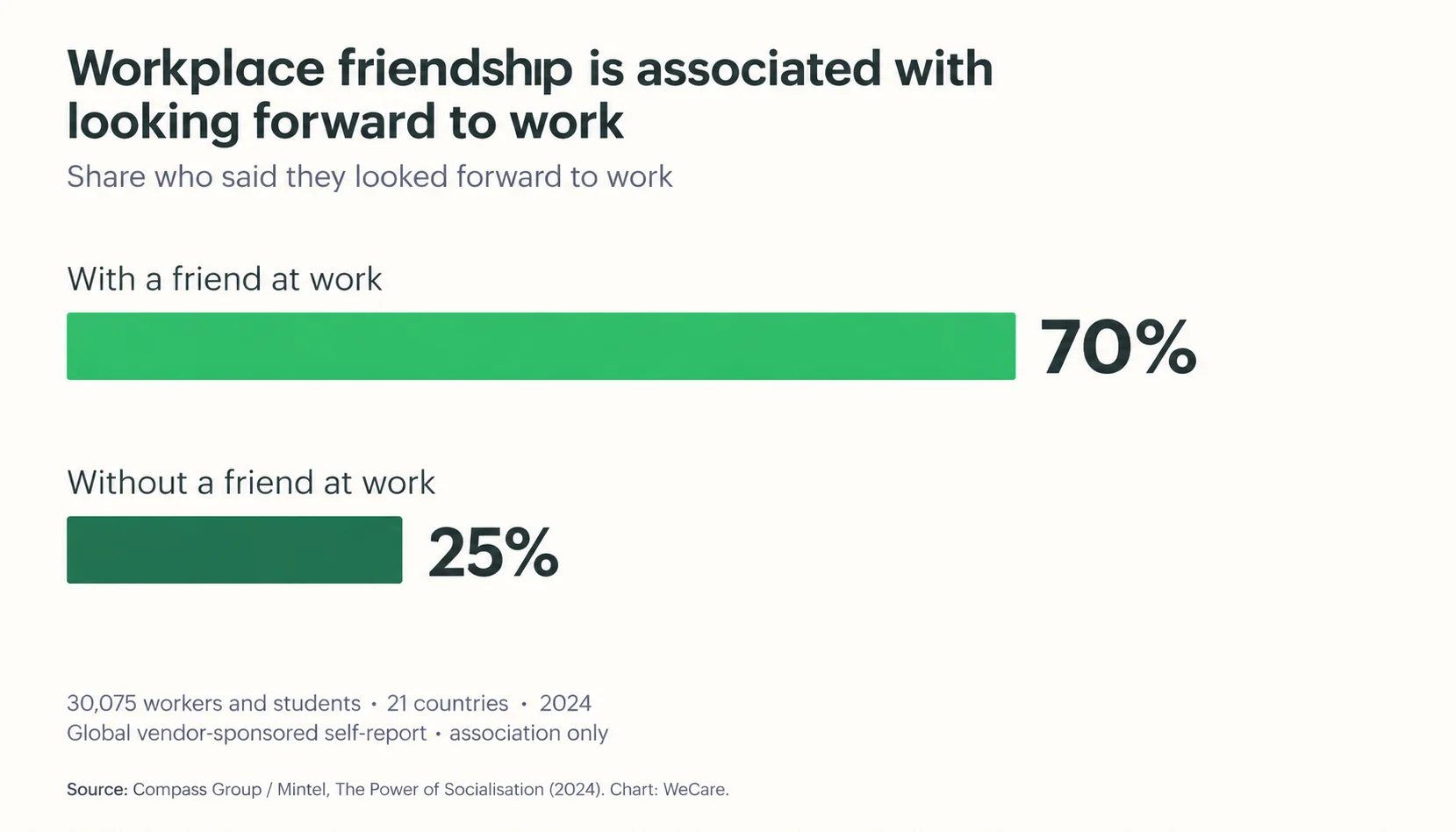 Horizontal bars show 70% of employees with a friend at work said they looked forward to work, compared with 25% without one.
Workplace friendship was associated with looking forward to work in a global vendor-sponsored survey. Source: Compass Group / Mintel, The Power of Socialisation (2024). Chart: WeCare.
This does not show that a shared meal created the friendship or improved engagement. It shows why connection should be measured separately from meal satisfaction.
Do shared meals automatically build workplace culture?
No. The social design around the meal matters.
A small US radiology pilot reported by Reichman and Dodelzon in 2026 organised three groups of seven colleagues for three dinners over six months, with facilitated discussion. Its abstract reports short-term improvements in selected wellbeing measures, but the programme combined food with structured conversation in a small, specialised group (Reichman & Dodelzon, 2026).
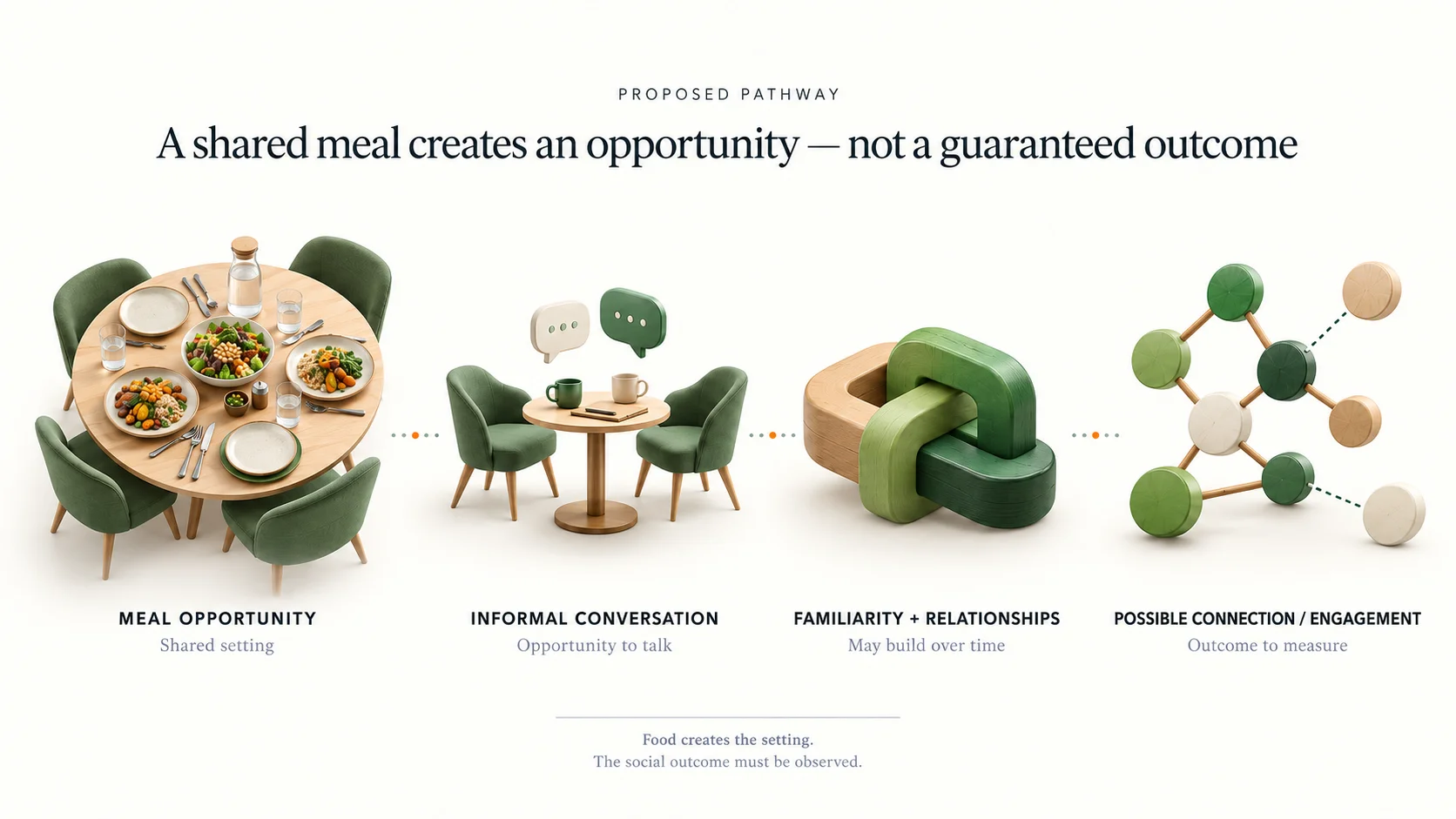 Object-based proposed pathway from a shared meal setting to informal conversation, relationship-building and possible connection or engagement.
Proposed pathway: food creates the setting; connection or engagement remains an outcome to observe and measure. Graphic: WeCare. Editorial synthesis informed by sources 1–3.
Food can create the setting; the social experience is the mechanism worth observing. Participation should remain voluntary rather than becoming compulsory “team bonding”.
Can shared meals improve employee productivity?
The evidence needs more caution here.
The Compass Group / Mintel 2024 report says 94% of frequent in-person lunch or break socialisers described their team as productive. That is a vendor-sponsored self-report, not an objective measure, and the supplied evidence provides no comparator (Compass Group / Mintel, 2024).
A stronger counterpoint comes from Belot and Hakimov's 2025 IZA working paper. In a randomised experiment across 100 offices, half received support for six social activities over three months in 2023. Researchers reported stronger relationships and improved office-level competition performance, but did not detect improved individual productivity (Belot & Hakimov, 2025).
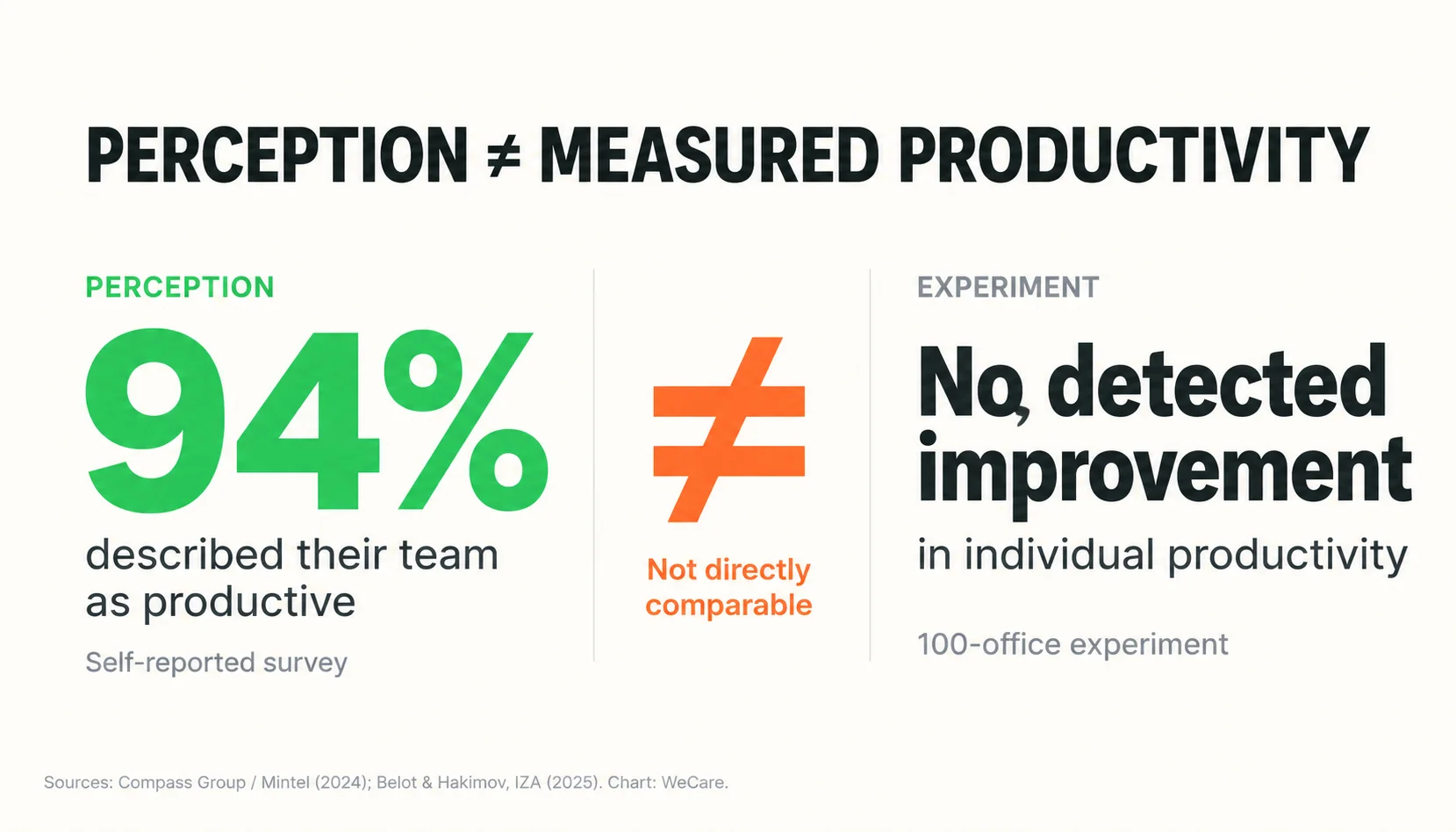 Graphic contrasts 94% self-reported team-productivity perception with a 100-office experiment that detected no improvement in individual productivity.
Perceived team productivity and measured individual productivity are different claims. Sources: Compass Group / Mintel (2024); Belot & Hakimov, IZA (2025). Chart: WeCare.
So perceived team productivity, office-level performance and measured individual productivity are different claims. HR should not use one as a substitute for another.
What should HR measure after introducing shared meals?
Start with the outcome closest to the meal, then move outward. This is a proposed framework, not a validated scale or industry benchmark.
| Proposed measure | What to record |
|---|---|
| Participation | Shared-meal participants ÷ eligible employees present, for the same period |
| Cross-team interaction | Whether employees spoke with someone outside their immediate team |
| Perceived connection | Whether meals created opportunities to know colleagues better |
| Work engagement | Existing appropriate, licensed engagement instrument |
| Performance | Preselected team output and quality measures |
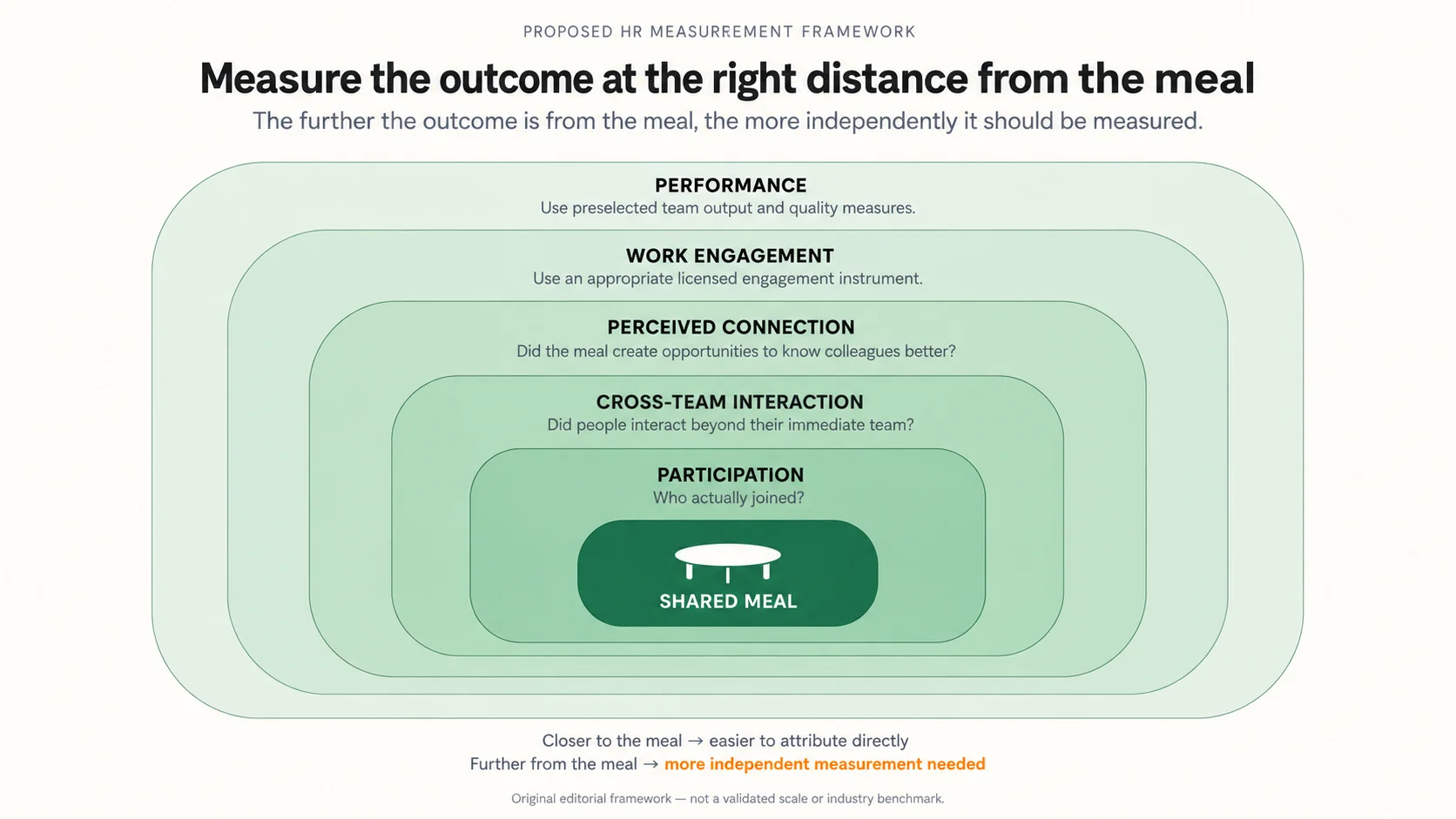 Nested framework separates shared-meal participation, cross-team interaction, perceived connection, work engagement and performance.
Proposed HR measurement framework separating immediate meal signals from broader workplace outcomes. Graphic: WeCare. Original editorial framework; not a validated scale or industry benchmark.
Participation does not prove stronger connection; stronger connection does not prove engagement or productivity improved.
What to do next
- Decide which outcome you want to influence.
- Establish a baseline before changing the meal experience.
- Track participation and cross-team interaction separately.
- Measure engagement and performance independently from meal feedback.
- Include non-participants when reviewing the result.
The evidence provides no universal participation target. Define eligibility and compare like periods with like.
Common questions
Does providing free food improve employee engagement?
The evidence used here does not establish that providing food itself causes higher engagement. The survey is associative, while the experiment tested a broader set of social activities.
Should team lunches be compulsory?
No. The editorial recommendation is voluntary participation, with attention to access barriers and preferences.
How often should teams eat together?
The evidence pack does not establish an optimum frequency. Choose a workable cadence and measure outcomes consistently rather than presenting a specific frequency as proven.
Can these findings be applied directly to Indian workplaces?
Not directly. The main evidence is international and does not establish an Indian workplace intervention effect. Treat it as evidence to inform local testing.
For a Bengaluru workplace meal requirement, contact WeCare.
Sources
- De Neve, Dugan, Kaats & Prati. “Sharing Meals with Others: How Sharing Meals Supports Happiness and Social Connections.” World Happiness Report 2025.
- Belot & Hakimov. “The Value of Bonding at Work: Evidence from a Field Experiment.” IZA Discussion Paper 17987, 2025.
- Reichman & Dodelzon. “Commensality Initiative: A Survey of Radiologists to Evaluate the Effects of Shared Meals on Burnout and Job Satisfaction.” Academic Radiology, 2026; online 2025. Abstract:
- Compass Group / Mintel. “The Power of Socialisation.” 2024.