What Makes Workplace Food Service Reliable?
Published on 23 October 2026 Aman Sagar 6 min read
To assess workplace food service reliability, start with agreed commitments: menu, portions, availability and service windows. Then check four areas—consistency, operating controls, accountability and verified improvement. Review observed results, how exceptions were handled and whether corrections held across comparable services. This is a practical assessment method, not a validated score.
A completed checklist can coexist with an unreliable lunch service. It records a check, not whether a commitment was met or corrected when missed.
 Illustrative corporate workplace cafeteria, showing a food-service counter and everyday lunch activity. This is an AI-generated scene, not a photograph of a WeCare or client facility.
Why doesn't a completed checklist prove reliable service?
Illustrative: A lunch counter is due to open at an agreed time. The checklist says “ready”; the review still needs the observed opening time and any exception.
Use WeCare’s four lenses: consistency, control, accountability and continuous improvement. They are assessment prompts, not a certified standard or independently validated reliability score.
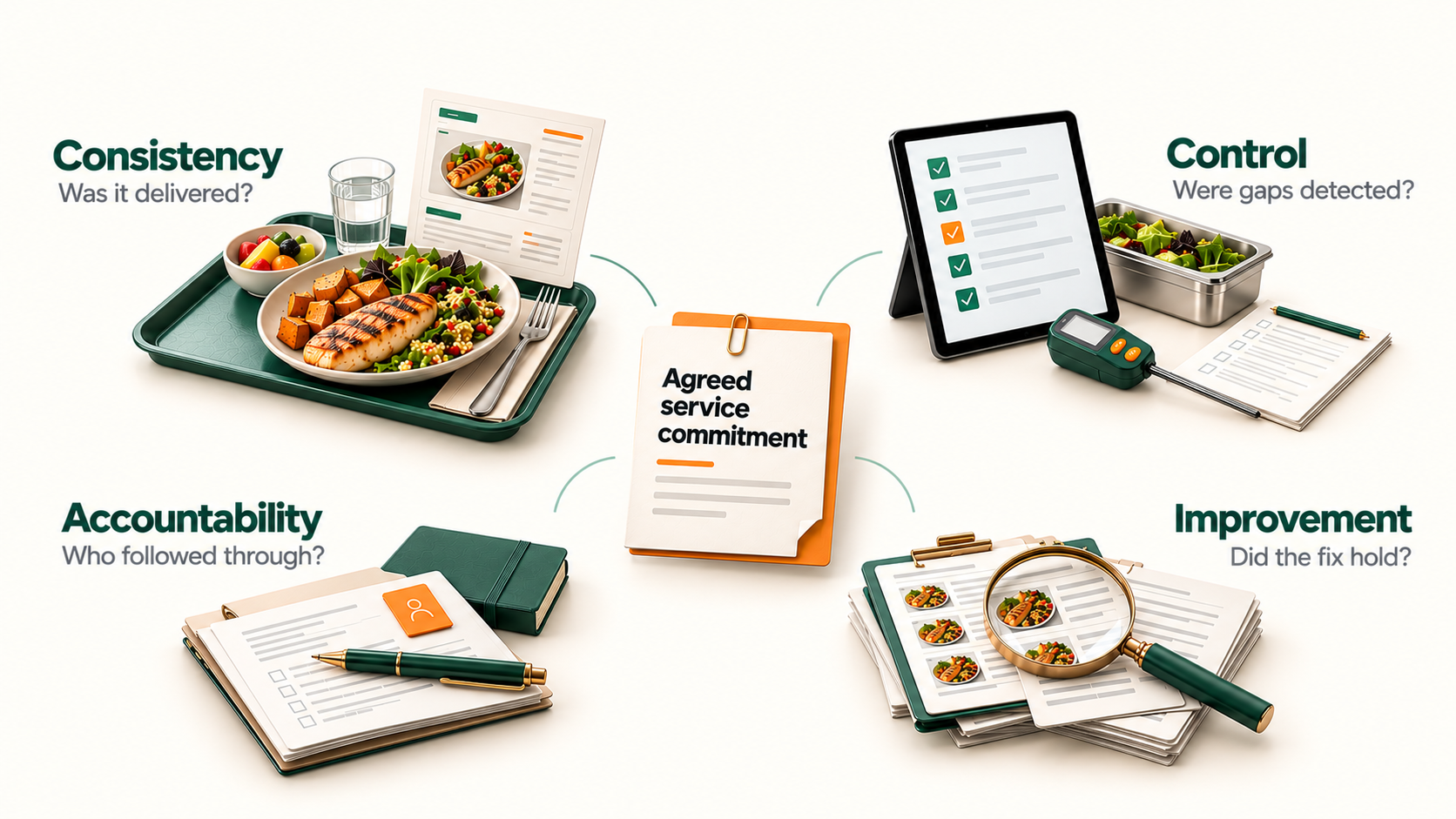 Illustrated framework: consistency, control, accountability and improvement examine one agreed food-service commitment.
The same service commitment can be reviewed through four lenses: consistency, control, accountability and improvement. WeCare editorial framework; not an independently validated score.
Consistency: was the agreed service delivered?
Define menu rotation, authorized substitutions, portions, availability and readiness. Compare records across services, keeping exceptions and missing observations visible.
In a US institutional-food evaluation, Wood and colleagues (2024) reported that limited data and resources prevented a full assessment of adherence. The work covered implementation during 2011–2021—not a current Indian cafeteria benchmark.
Consistency includes delivering planned variety. It does not mean serving the same menu every day.
For related service context, see WeCare’s recurring workplace meals page.
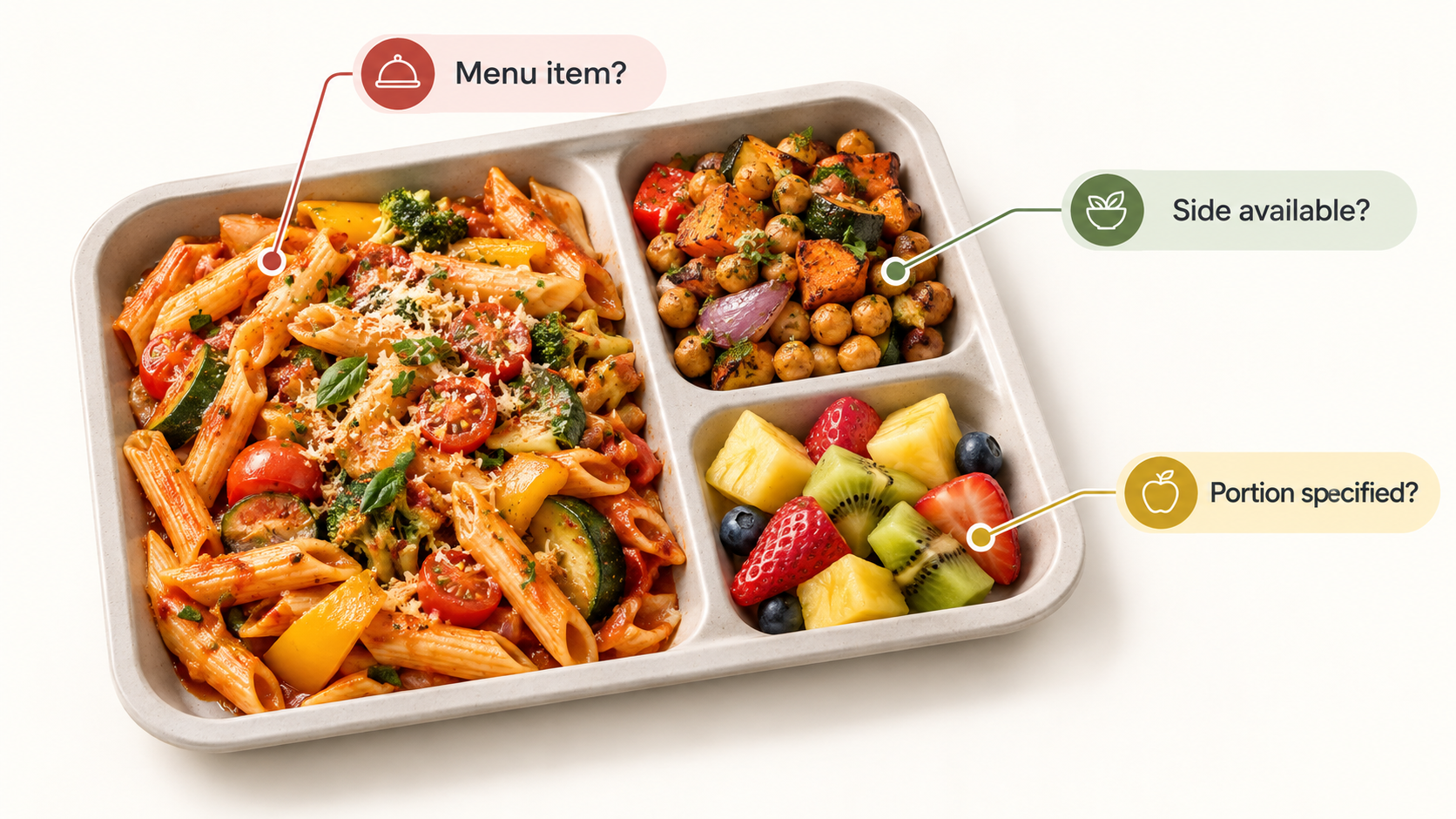 Annotated vegetarian corporate lunch tray identifies a pasta main, a chickpea-and-vegetable side, and fruit.
Illustrative cafeteria meal showing three food components. The current labels identify dishes rather than the agreed service requirements; final callouts need review before publication. One tray does not demonstrate variety across services.
Control: what happens when a check fails?
Ask when the counter opened and what happened after a missed check. Keep hygiene deviations separate from taste and menu feedback. Do not hide serious safety exceptions inside an average score.
The FAO/WHO Codex hygiene principles (2023 edition) cover monitoring, correction, verification and records. FSSAI’s catering guidance (2017) offers older implementation guidance; it does not replace regulations. Applying these principles to the wider service review is an editorial recommendation, not a legal requirement.
| Review prompt | Evidence | Follow-up |
|---|---|---|
| Was it checked? | Dated record | Was it on time? |
| What happened? | Observed result | Was the criterion met? |
| What followed? | Response record | Was the response checked? |
Accountability: who owns the outcome?
Trace a missed opening time through investigation, response and closure. Check the assigned owner, outstanding actions and evidence used to close it. A reply alone is not resolution.
The public ISO 10002:2018 description covers complaint analysis and effectiveness review—not certification or any operator’s performance.
Responsibility should remain visible until the outcome can be checked.
 Illustrative facilities representative reviews a service record beside a corporate cafeteria counter.
An illustrative facilities representative checks a service record at a workplace cafeteria. AI-generated scene; not actual WeCare staff or a documented client incident.
Continuous improvement: did the correction work?
Getting the counter open again restores service; completing a corrective action is a separate milestone. Neither, by itself, proves that a recurring problem will not return.
ISO Auditing Practices Group guidance (2016) discusses checking effectiveness before closing an audit finding. It is educational guidance, not a cafeteria-specific requirement. Agree which comparable later services to check, and continue monitoring after verified closure.
Complaints are only one input. ISO APG’s customer-feedback guidance (2016) cautions against treating them as the only source of feedback.
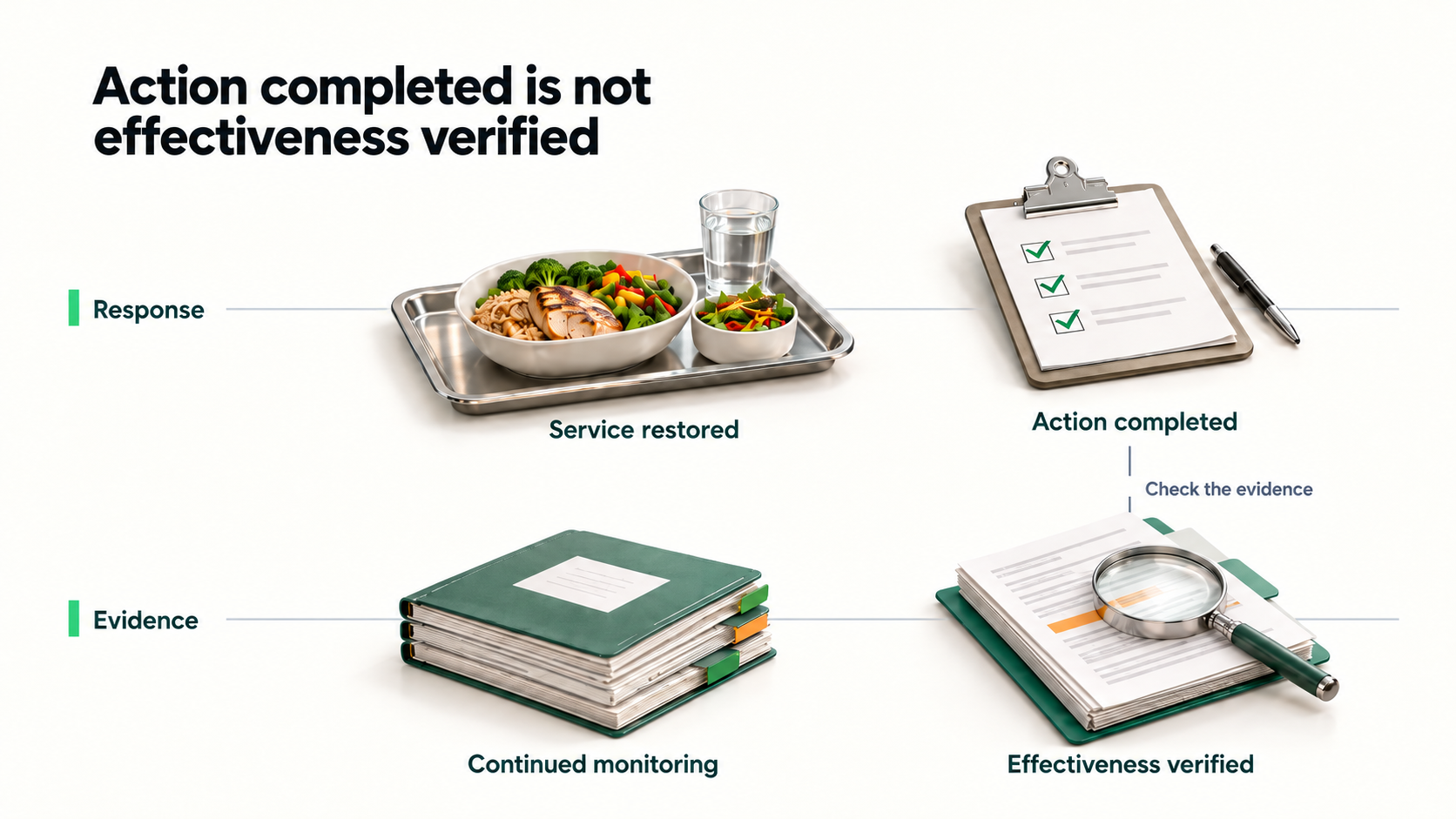 Two conceptual lanes contrast restored service and completed action with verified effectiveness and continued monitoring.
Response and verification require different evidence. Continued monitoring follows the effectiveness review. Original conceptual synthesis informed by ISO APG (2016); not a mandatory cafeteria process or measured result.
How do you assess workplace food service reliability?
Use one agreed commitment across all four lenses. Instead of assigning a score, identify the record supporting each answer.
| Lens | Question | Evidence to request |
|---|---|---|
| Consistency | Was it delivered? | Observations, exceptions |
| Control | Were gaps detected? | Check results, responses |
| Accountability | Who followed through? | Owner, closure record |
| Improvement | Did the fix hold? | Later comparable services |
WeCare’s operating model (undated; accessed 2026) describes issue resolution and operational improvement as separate stages. This is a first-party method description, not independently verified performance data.
What to do next
- Choose one commitment, such as counter readiness at the agreed time, and define the record that would show delivery.
- Review a stated period of observations, exceptions and missing records. Identify who responded when commitments were missed.
- Trace one recurring issue through corrective action and comparable later services. Agree what counts as verified improvement and when to check again.
Common questions
What should we measure first?
Start with an agreed commitment, such as counter readiness at the stated time. Include missing observations in the review; this guide does not establish an industry benchmark.
Does consistency mean the same menu every day?
No. It means meeting the agreed rotation, specifications and authorized substitutions—not repeating identical food every day.
When should an issue be considered resolved?
Not simply when service resumes. Agree how to verify the action’s effectiveness, using follow-up observations appropriate to the issue.
Is this a certified industry standard?
No. The four pillars are WeCare’s practical editorial framework informed by the cited guidance, not a validated rating or certification scheme.
Explore how WeCare operates for its approach to workplace food in Bengaluru.
Sources
- Wood M, Robles B, Beltran J and Kuo T. “Integrating Healthy Nutrition Standards and Practices Into Food Service Contracting in a Large US County Government.” Preventing Chronic Disease, 2024. Implementation period: 2011–2021.
- FAO and WHO. General Principles of Food Hygiene, 2023 edition (revised 2022).
- FSSAI. Catering Food Safety Management System Guidance, first edition 2017; online file dated 2018. Older implementation guidance, not current regulations.
- ISO. ISO 10002:2018 — Guidelines for complaints handling in organizations. Public description only; standard text not assessed.
- ISO 9001 Auditing Practices Group. Nonconformity—Review and Closing. 2016. Educational, non-definitive guidance.
- ISO 9001 Auditing Practices Group. Customer Feedback. 2016. Educational, non-definitive guidance.