Workplace Nutrition: From Menu to Lunch Counter
Published on 3 November 2026 Aman Sagar 6 min read
A workplace nutrition programme in India starts with agreed menu criteria, service checks and documented review.
Translate dietary guidance into food choices employees can access throughout service. Review selections, feedback and waste using consistent definitions. This proposed approach assesses delivery and employee response; wellbeing gains need separate evidence.
Illustrative: An employee arrives late in the lunch window. The grain-and-bean bowl has run out. The workplace manager investigates when it was available and what happened before service ended.
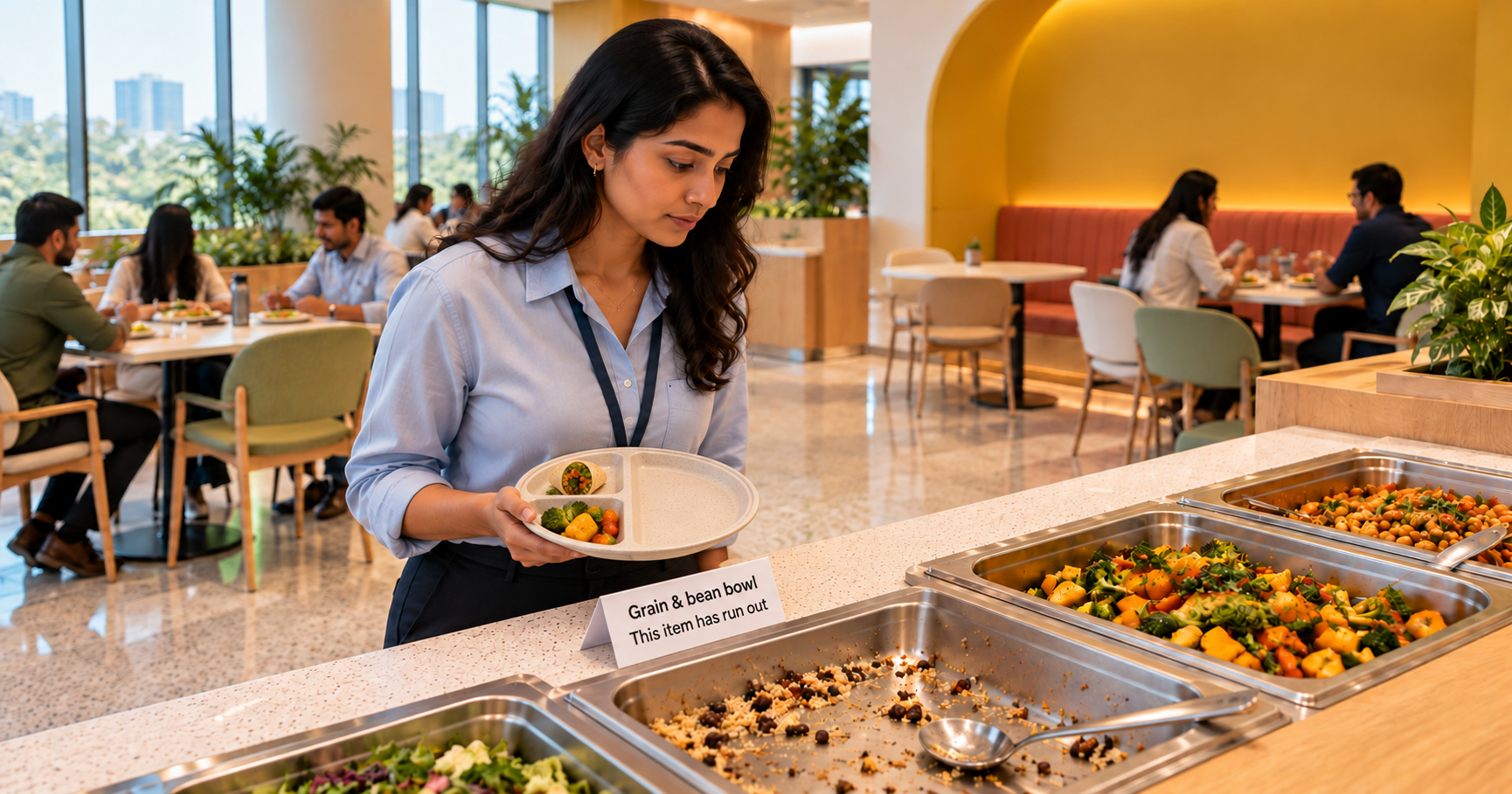 Representative scene, not a WeCare site or client event. Image: WeCare.
How can a cafeteria put nutrition guidance on the menu?
Agree ingredients and preparation for each dish. The Indian Council of Medical Research–National Institute of Nutrition's 2024 dietary guidelines emphasise variety across food groups. The World Health Organization's 2026 guidance identifies adequacy, balance, moderation and diversity as foundations of a healthy diet.
Translate those principles into a menu brief the operating team can use:
| Illustrative choice | Agree before service |
|---|---|
| Grain-and-bean bowl | Ingredients and approved substitutes |
| Whole-wheat vegetable-and-bean wrap with lentil soup | Recipe, preparation and service feasibility |
| Cooked vegetables, whole fruit or plain yoghurt | Availability checks and relevant dietary requirements |
These illustrative choices are not nutritionally analysed menus or confirmed WeCare offerings. Agree pricing and ingredient information before introducing them.
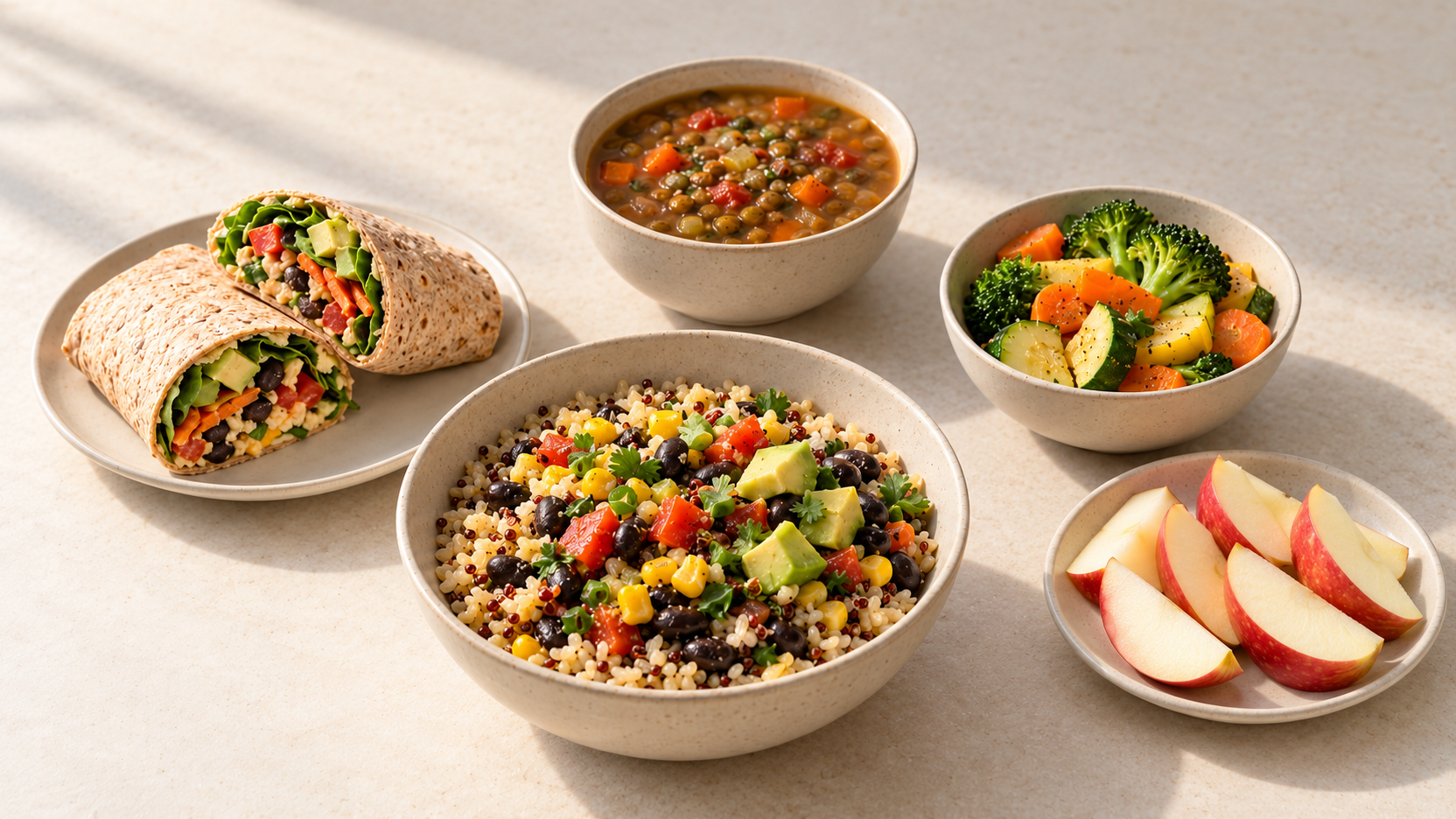 Illustrative menu choices, not a prescribed lunch or confirmed WeCare menu. Image: WeCare.
How do you check what employees can actually choose?
Record what reaches the counter throughout lunch. In Becker et al.'s 2026 trial, replacing a meat-based option with a vegetarian option increased vegetarian-purchase odds by 41% (95% confidence interval: 28%–55%). The seven-week trial covered six English cafeterias and 26,170 meal sales in 2023.
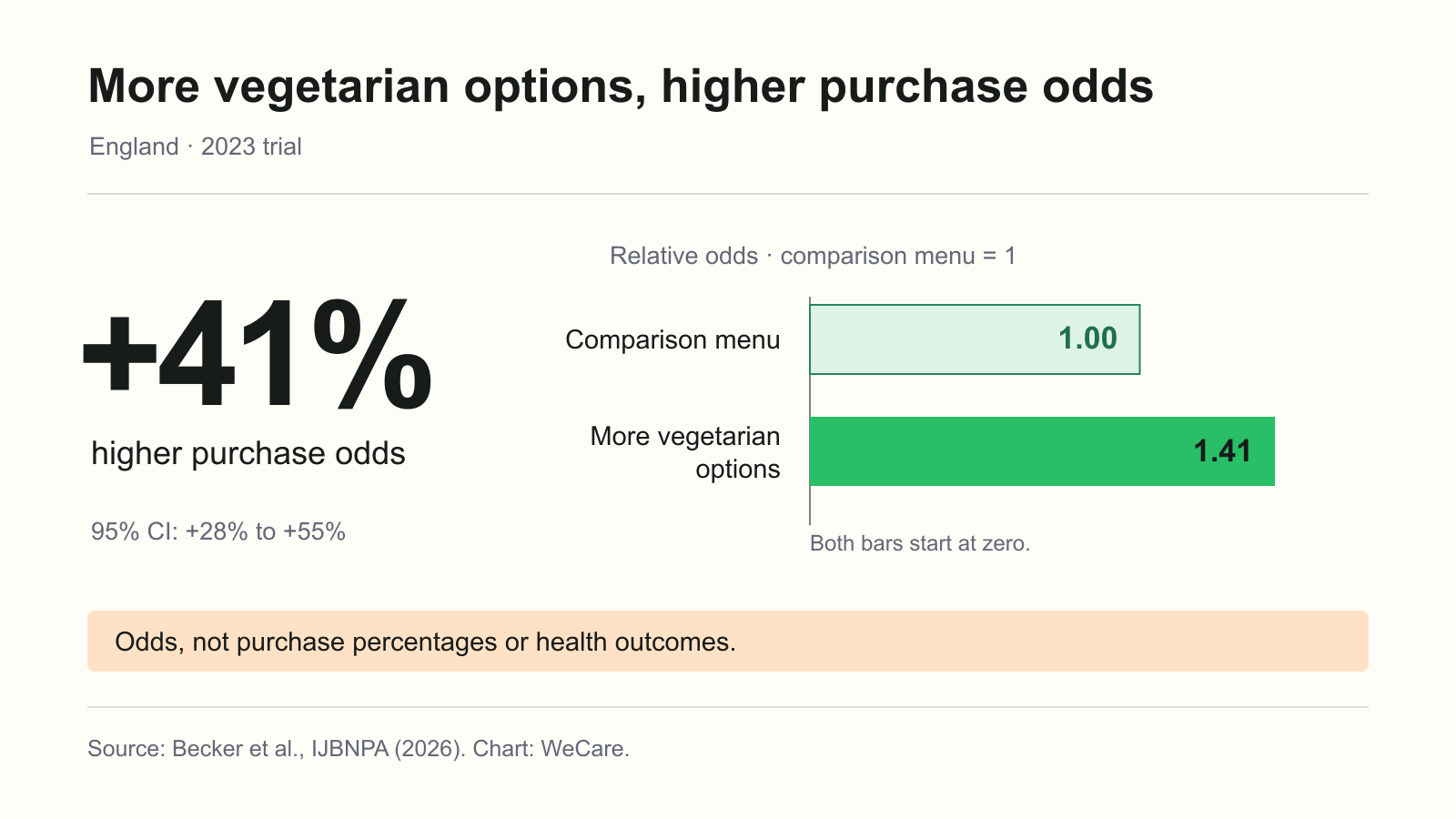 Relative vegetarian-purchase odds were 1.41 with more vegetarian options versus a comparison reference of 1.00, with a 95% confidence interval of 1.28–1.55.
Normalized purchase odds, not purchase percentages. Source: Becker et al., worksite cafeteria trial (2026). Chart: WeCare.
Higher odds do not mean a 41-percentage-point rise in purchases. This is purchase evidence from England, not an Indian effect estimate or proof of better health.
Agree opening, middle and late checks. Record substitutions and missed observations separately; checks cannot establish uninterrupted availability.
Which cafeteria metrics should workplace managers track?
Separate delivery, choice and health. Dai et al.'s 2025 review covered 68 papers: 39 assessed food environment, 23 consumer behaviour, 16 diet quality and six health.
The categories overlap and span mixed institutions; the counts show research coverage, not successful interventions. The initial search was in July 2022, with later citation additions. Financial outcomes are omitted here.
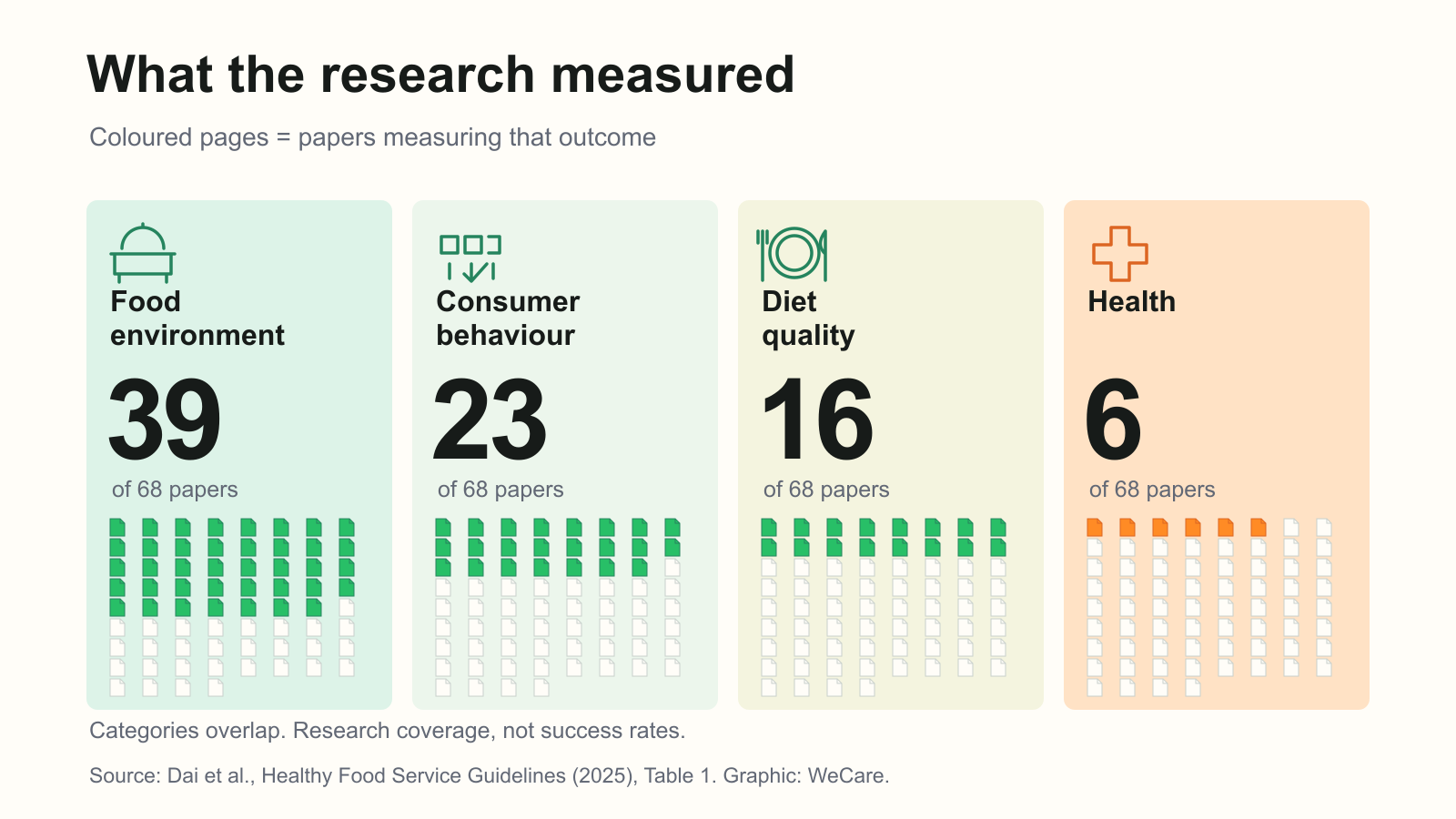
Paper counts, not success rates. Source: Dai et al., Healthy Food Service Guidelines for Worksites and Institutions (2025), Table 1. Graphic: WeCare.
Agree definitions before using this proposed scorecard:
| Measure | Proposed calculation | Interpretation check |
|---|---|---|
| Menu delivery | Agreed items or approved substitutes supplied ÷ all agreed items | Count each menu position once; retain substitution records |
| Observed availability | Successful item-checks ÷ completed scheduled item-checks | List missed checks separately |
| Choice uptake | Transactions containing the option ÷ eligible lunch transactions | Same period and format; transactions are not unique diners |
| Satisfaction | Favourable valid responses ÷ all valid responses | Show response count and eligible diner base |
| Unserved edible waste | Edible prepared food discarded before serving ÷ edible food prepared, by mass | Keep plate waste separate |
Multiply ratios by 100 for percentages. These definitions are proposals, not validated wellbeing measures or verified WeCare reporting capabilities. If ratings rise while response counts fall, inspect the response base before concluding satisfaction improved.
How would you test a change when a dish runs out?
Illustrative, continuing the bowl example: Compare the menu, counter observations and replenishment record. Ask about taste and price before agreeing a limited replenishment adjustment. Track availability, selections, feedback and separate waste streams.
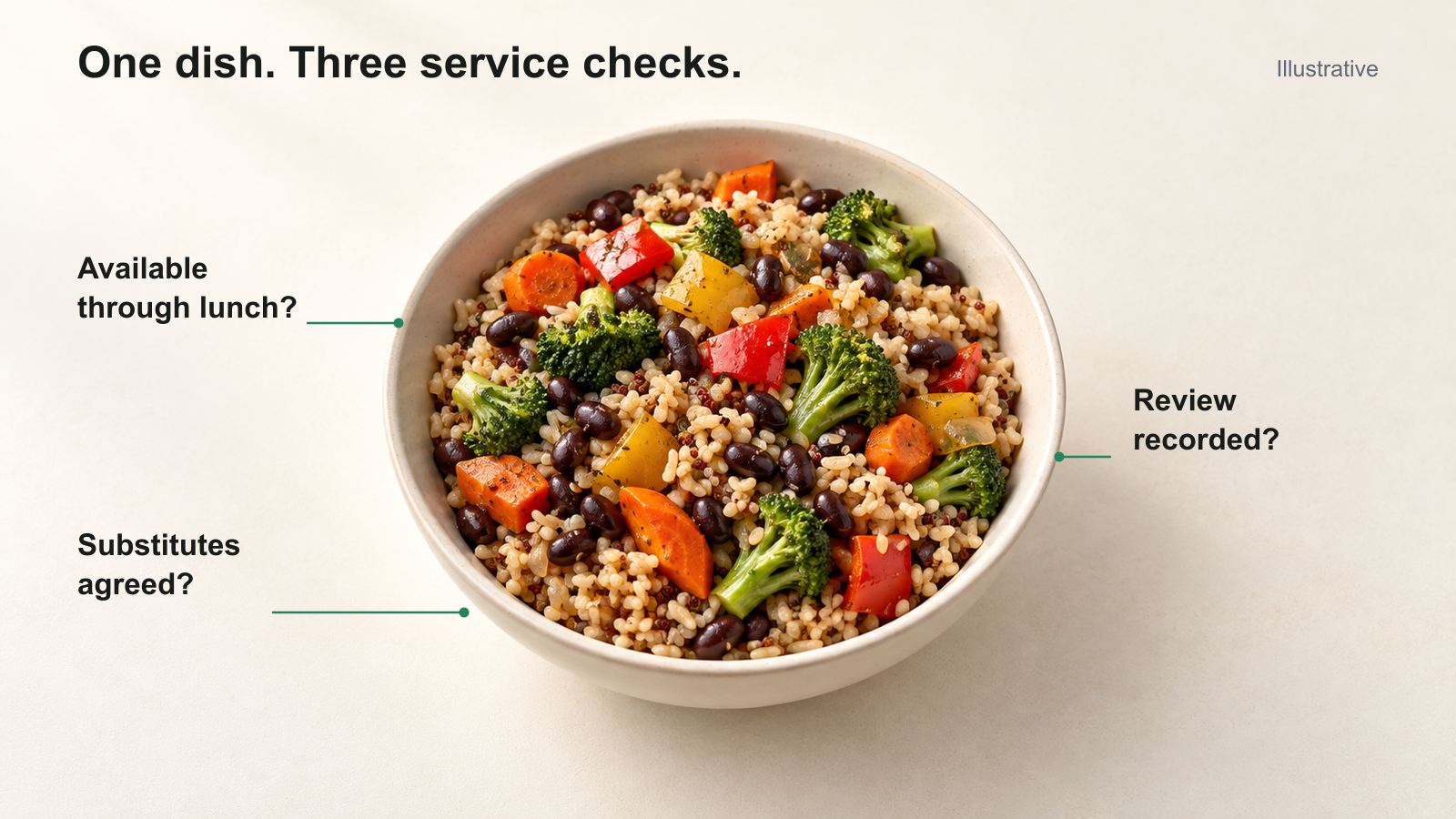
Illustrative service checks, not nutritional analysis. Image and annotations: WeCare.
At review, retain, adjust or stop the change. Extend the test if records are incomplete. If the bowl stays available but attracts little interest, investigate employee response before increasing production.
How can you start a workplace nutrition review in India?
Name a client owner and agree the operator's responsibilities. The Global Alliance for Improved Nutrition's 2026 implementation paper, including Indian experience, highlights management ownership and organisational routines. It reports programme-team perspectives, not an independent causal evaluation.
Use this original proposed schedule: days 1–7, establish a baseline; 8–14, agree one feasible change; 15–21, test and record; 22–30, review and decide. These dates are planning choices, not a proven intervention duration or contractual promise.
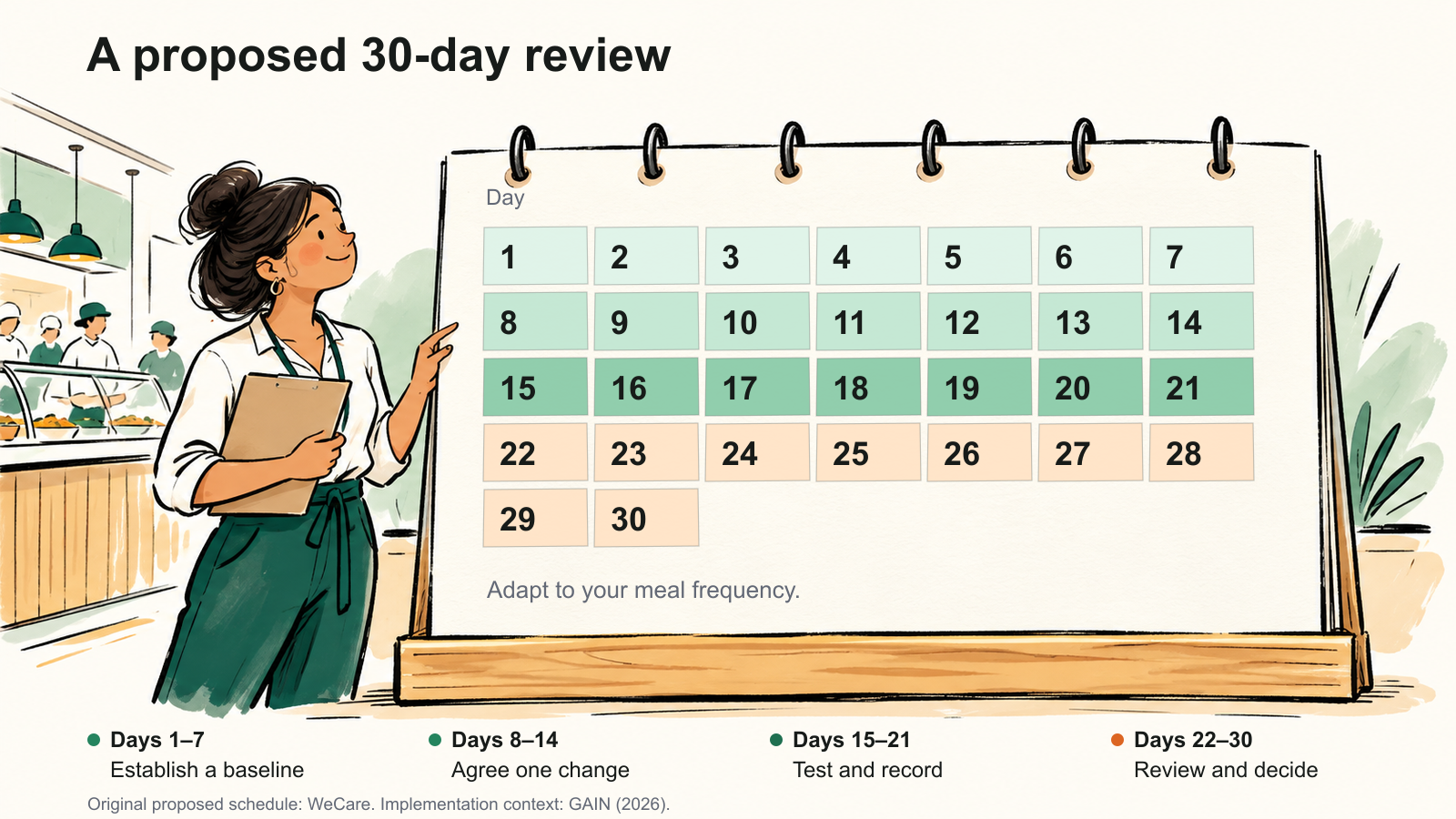
Original proposed schedule, not a validated duration. Implementation context: GAIN (2026). AI-generated illustration and calendar: WeCare.
Compare similar services; record attendance, price and menu changes. Weekly programmes may need longer to collect useful observations.
Quak et al. (2025) identify a potential business case. Rogerson et al. (2026) report uncertainty about organisational outcomes and attribution. A before-and-after review alone cannot establish causation.
What to do next
- Choose one menu item and agree its criteria and substitutes.
- Name an owner and record availability, employee response and waste consistently.
- Set a review date and decide whether to retain, revise, extend or stop the change.
For the illustrative bowl, record the next service change and who will check it.
Common questions
Does vegetarian automatically mean nutritionally balanced?
No. Becker et al. (2026) caution that vegetarian substitutions can differ in nutritional quality. Assess the agreed recipe and ingredients.
Can cafeteria ratings prove better employee wellbeing?
Treat ratings as food-experience feedback. Health needs its own measures; Dai et al. (2025) assess these outcomes separately.
Who should review employee food feedback?
Agree ownership. In the WeCare-confirmed account (2026), the client owns review: one reported practice, not a universal rule.
WeCare describes its Bengaluru operation as end-to-end, including procurement and internally managed kitchens (company description, accessed 2026). Explore how WeCare operates to discuss responsibilities for your Bengaluru workplace.
This is general information about workplace food, not medical or dietary advice.
Sources
- ICMR–NIN (2024). Dietary Guidelines for Indians.
- Becker et al. (2026). Vegetarian meal availability and purchases in worksite cafeterias. England trial, 2023.
- Dai et al. (2025). Healthy Food Service Guidelines for Worksites and Institutions. Table 1.
- Rogerson et al. (2026). Workplace dietary interventions and organisational outcomes.
- GAIN (2026). Advocating for Workforce Nutrition. Implementation context; the 30-day schedule is an original proposal.