Why Employee Food Experience Matters at Work
Published on 15 October 2026 Aman Sagar 7 min read
An office lunch can taste good and still feel like a poor break when queues are long or service starts late.
Employee food experience at work includes food quality, meaningful choice, convenience, reliable service and a comfortable place to eat. HR can measure these direct outcomes with consistent feedback and service records. Wider engagement or productivity gains require separate evidence; satisfaction with lunch alone cannot establish either outcome.
Illustrative: An employee likes the meal but waits for the counter to open. A taste-only survey misses the frustration.
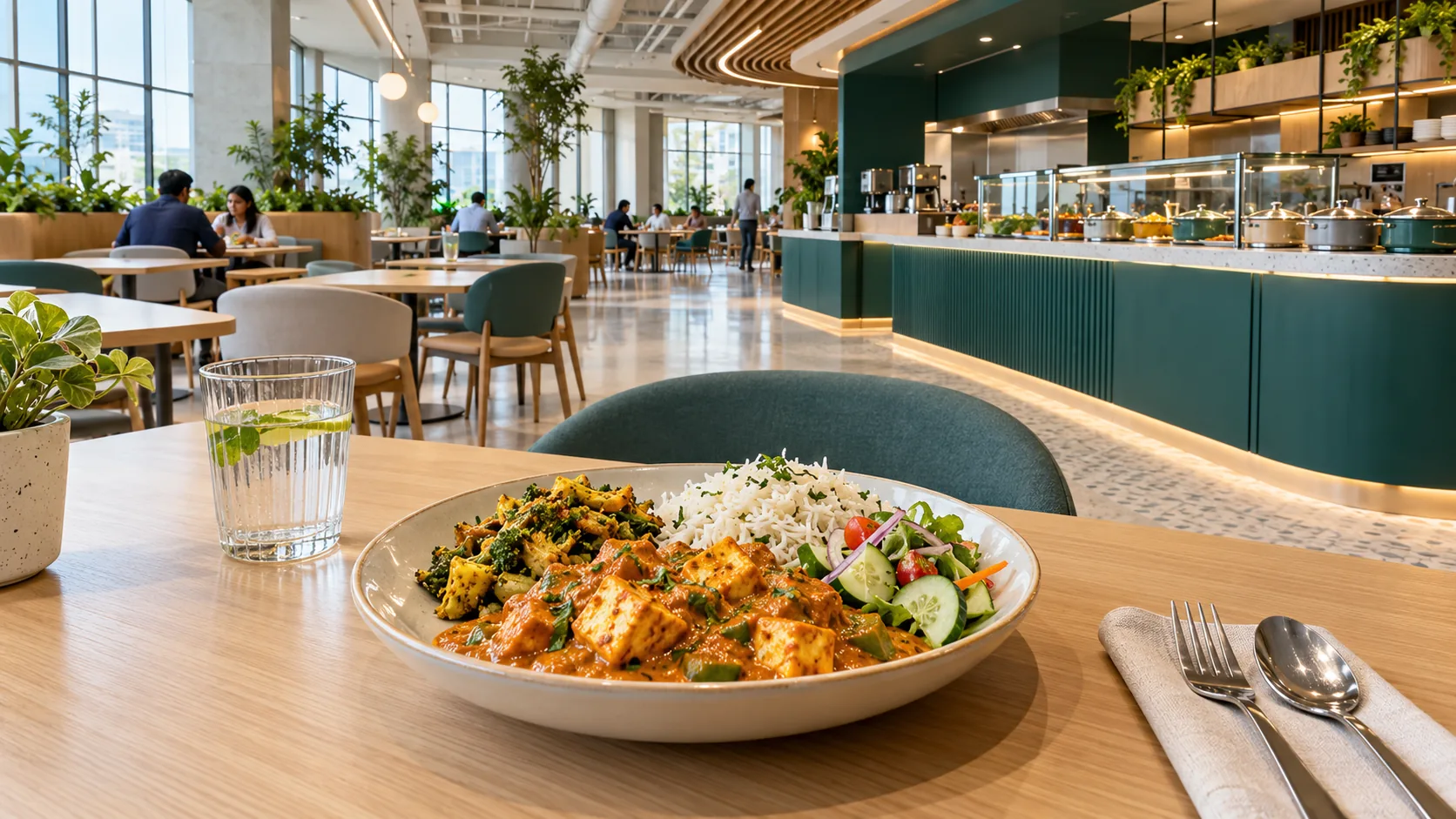 Conceptual corporate cafeteria scene with a professionally plated lunch in the foreground and a workplace serving counter behind it.
Why does employee food experience at work matter?
CBRE's 2025 India Office Occupier Survey reports that 73% of responding companies intended to focus on physical workplace design to improve office experience. More than 100 C-suite executives were surveyed; this is not a cafeteria-impact measure (CBRE, 2025).
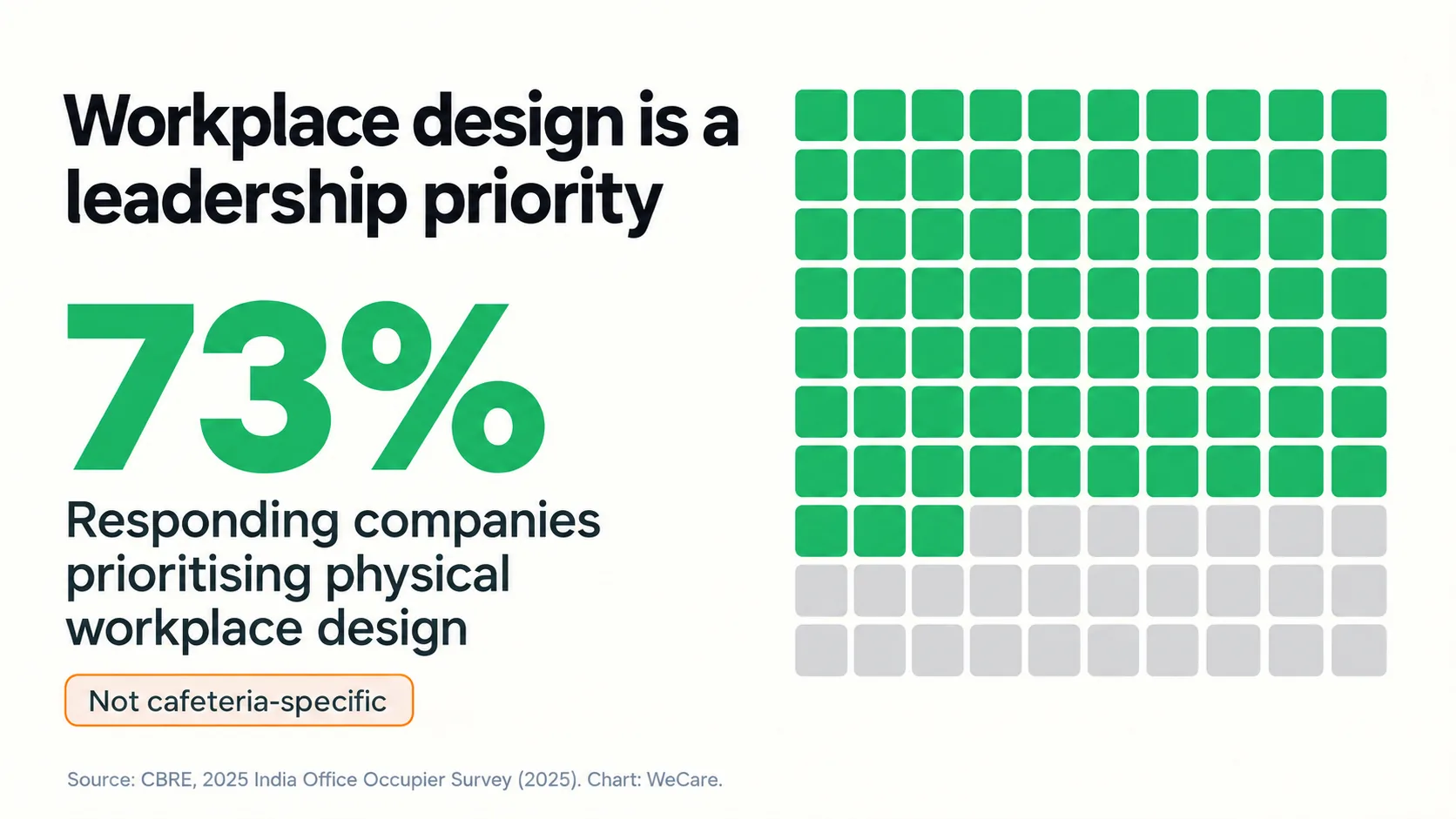 A 100-square chart highlights 73 squares for responding Indian companies intending to prioritise physical workplace design, not specifically cafeterias.
73% of companies responding to the 2025 India Office Occupier Survey intended to focus on physical workplace design, not specifically cafeterias. Source: CBRE, 2025 India Office Occupier Survey (2025). Chart: WeCare.
In ISS's vendor-led 2025 survey of nearly 11,000 office workers across 15 countries, food experiences were the most-selected improvement respondents said would encourage more frequent office attendance (ISS, 2025). It captures what people said they wanted, not an observed increase in attendance.
What makes a positive office cafeteria experience?
Azevedo et al. (2025) reviewed 54 studies of organisational food environments and identified 36 assessment instruments; 29 had some information about validity or reproducibility (Azevedo et al., 2025). The settings included companies, hospitals and universities. These are research counts, not satisfaction percentages.
For an HR review, consider food quality, choice, convenience, consistency, dining space and feedback. This is an editorial checklist, not a validated scale. The employee from the opening liked the food, but service timing still spoiled the break.
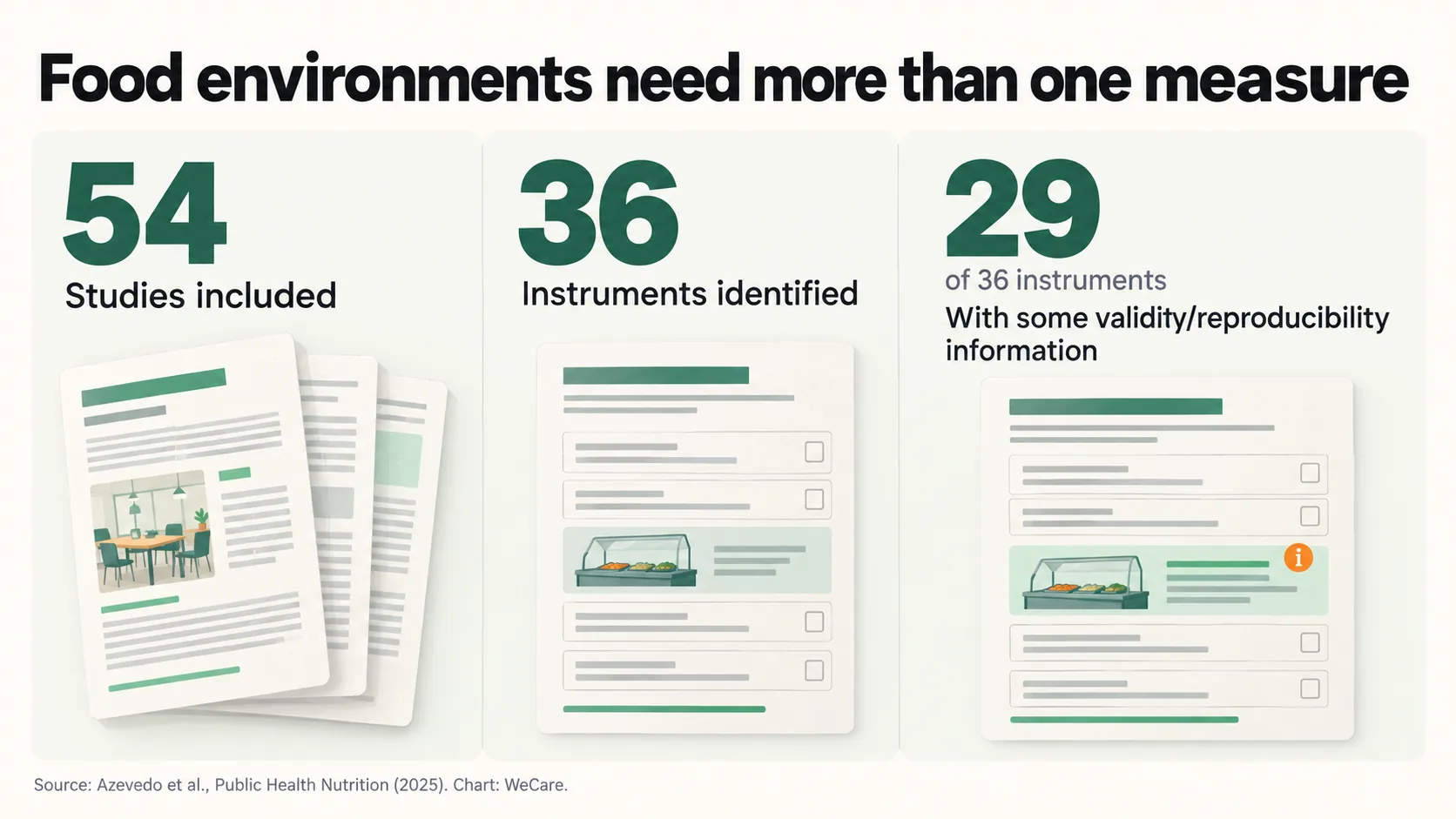 Three illustrated tiles show 54 studies, 36 assessment instruments and 29 of those instruments with some validity or reproducibility information.
A 2025 scoping review included 54 studies, identified 36 assessment instruments, and found that 29 of the instruments reported some validity or reproducibility information. These are distinct counts, not employee satisfaction rates. Source: Azevedo et al., Public Health Nutrition (2025). Chart: WeCare.
Can workplace food create opportunities for connection?
Lemon, Topić-Rutherford and Bawole (2026) interviewed 21 public-relations professionals and described food-related conversations as occasions for welcoming colleagues and building informal relationships (Lemon et al., 2026). Their qualitative study suggests possible social opportunities; it does not measure cafeteria-driven engagement gains in Indian offices.
Illustrative: One employee wants conversation; another prefers quiet. A welcoming space supports both.
Experience check: An opportunity to connect is not the same as a measured improvement in engagement.
Does better cafeteria food improve productivity?
Belot and Hakimov's revised 2026 working paper reports a randomised trial of organised social activities at a microfinance company in Kyrgyzstan, analysed across 101 offices and 98 teams. Three standardised collegiality measures showed estimated improvements of +0.252, +0.224 and +0.202 standard deviations. The July 2023 office-competition result was an estimated +21.22 points on a company-specific measure, but no improvement in individual productivity was statistically detected (Belot & Hakimov, 2026). These were workplace social activities, not cafeteria improvements.
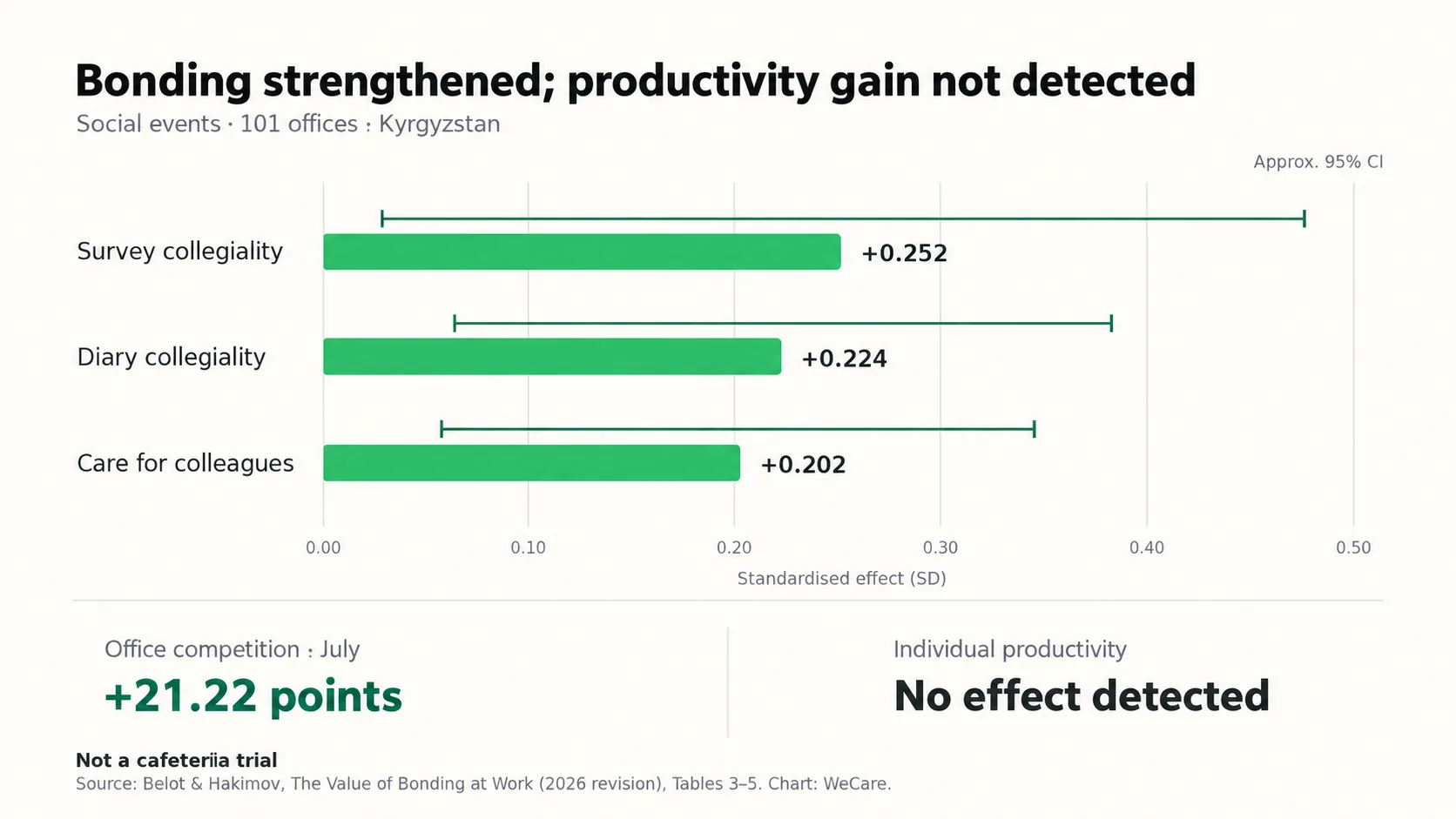 Three horizontal bars show collegiality effects of plus 0.252, plus 0.224 and plus 0.202 standard deviations, while the study detected no individual productivity gain.
In a Kyrgyzstan social-events experiment, three collegiality indices improved by about 0.20–0.25 standard deviations. A July office-competition estimate was +21.22 points (98 teams); no individual productivity effect was detected. Whiskers are approximate nominal 95% intervals calculated from published coefficients and clustered standard errors. Not a cafeteria trial. Source: Belot & Hakimov, The Value of Bonding at Work, January 2026 revision, Tables 3–5. Chart: WeCare.
That cautions against overclaiming, not against improving lunch. A shorter queue may make a break easier to use. It does not, by itself, establish higher engagement or work output; those outcomes need their own measures and comparisons.
How should HR measure employee food experience?
Ask users the same questions before and after a dated change: food, choice, waiting, readiness, space and feedback. Record eligible on-site employees, actual users and respondents. A positive rating means little without knowing who answered.
| Direct signal | Suggested record |
|---|---|
| Food satisfaction | Positive responses / survey respondents, with response rate |
| Service readiness | Services ready on time / scheduled services |
| Repeat complaints | Repeated issues / issues logged, consistently defined |
| Participation | Unique users / eligible on-site staff |
At Lifesight in Bengaluru, WeCare's 2026 case study includes photographs of feedback logs dated 19 June, 7 August and 11 September 2026 and describes feedback review alongside menu and quantity planning (WeCare, 2026). The responses were not independently inspected. This is process evidence, not proof of higher satisfaction.
Use record → classify → change → verify → ask again. If a problem returns, investigate its cause. See How WeCare operates for the wider approach.
Study social opportunity, engagement and productivity separately. Each is further from the meal itself, making an effect harder to attribute to food.
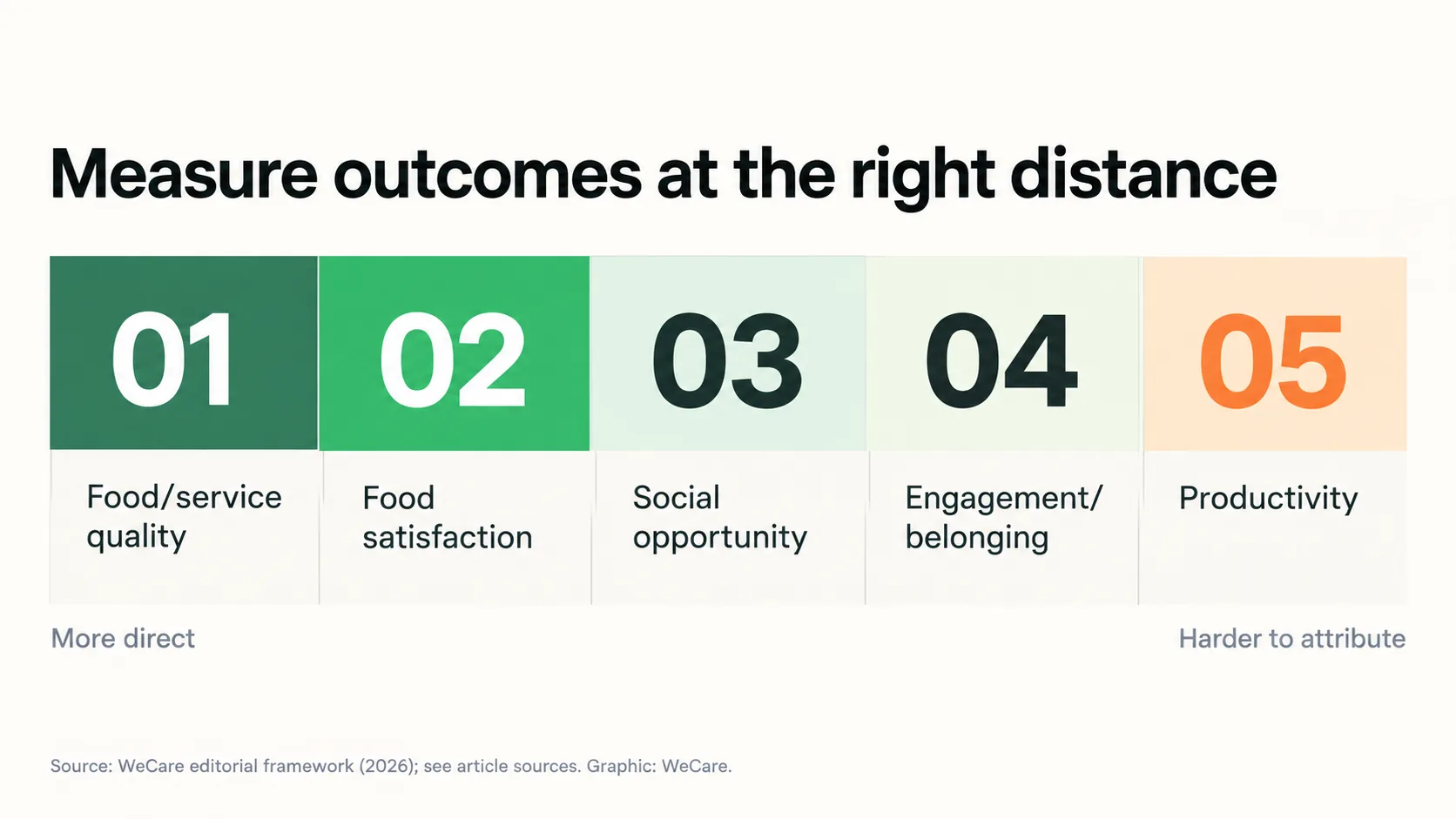 Five-stage framework progresses from food-service quality to food satisfaction, social opportunity, engagement and productivity, indicating increasing attribution difficulty.
WeCare editorial assessment framework: food-service experience is more directly measurable than social and organisational outcomes. The stages show evaluation distance, not a proven causal chain. Source: WeCare editorial framework (2026), informed by the article’s cited research. Graphic: WeCare.
What to do next
- Set a baseline: ask consistent questions and report response counts.
- Close the loop: track recurring issues, corrections and verified closure.
- Separate outcomes: review broader HR indicators independently.
Common questions
Does better cafeteria food increase employee engagement?
It may improve satisfaction with the food service and create opportunities for contact. The cited evidence does not establish a cafeteria-caused engagement gain.
What should HR measure first?
Start with cafeteria satisfaction, service readiness, queues, repeat complaints and survey denominators.
Does workplace lunch improve individual productivity?
That has not been established here. The cited randomised experiment studied social events, not cafeteria changes.
How often should companies review cafeteria feedback?
Check before and after dated changes, then keep reviewing recurring issues. The research does not specify a universal interval.
Read WeCare's Lifesight case study to see how feedback fits into recurring workplace-lunch planning.
Sources
- CBRE. “2025 India Office Occupier Survey.” 2025.
- ISS. “The office holds the key to reinforcing culture and belonging.” 2025.
- Azevedo, A. B. C. et al. “Instruments for assessing organisational food environments of workplaces: a scoping review.” Public Health Nutrition. 2025.
- Lemon, L. L., Topić-Rutherford, M., and Bawole, C. “Breaking bread to build coworker relationships.” Public Relations Review. 2026.
- Belot, M., and Hakimov, R. “The Value of Bonding at Work: Evidence from a Field Experiment.” Author-hosted revised working paper, January 2026, Tables 3–5.
- WeCare. “How Lifesight Improved Its Workplace Lunch Experience.” 2026. https://wecare.food/case-studies/lifesight-workplace-lunch-experience